

VATESI annual publication “Nuclear Power Safety in Lithuania”
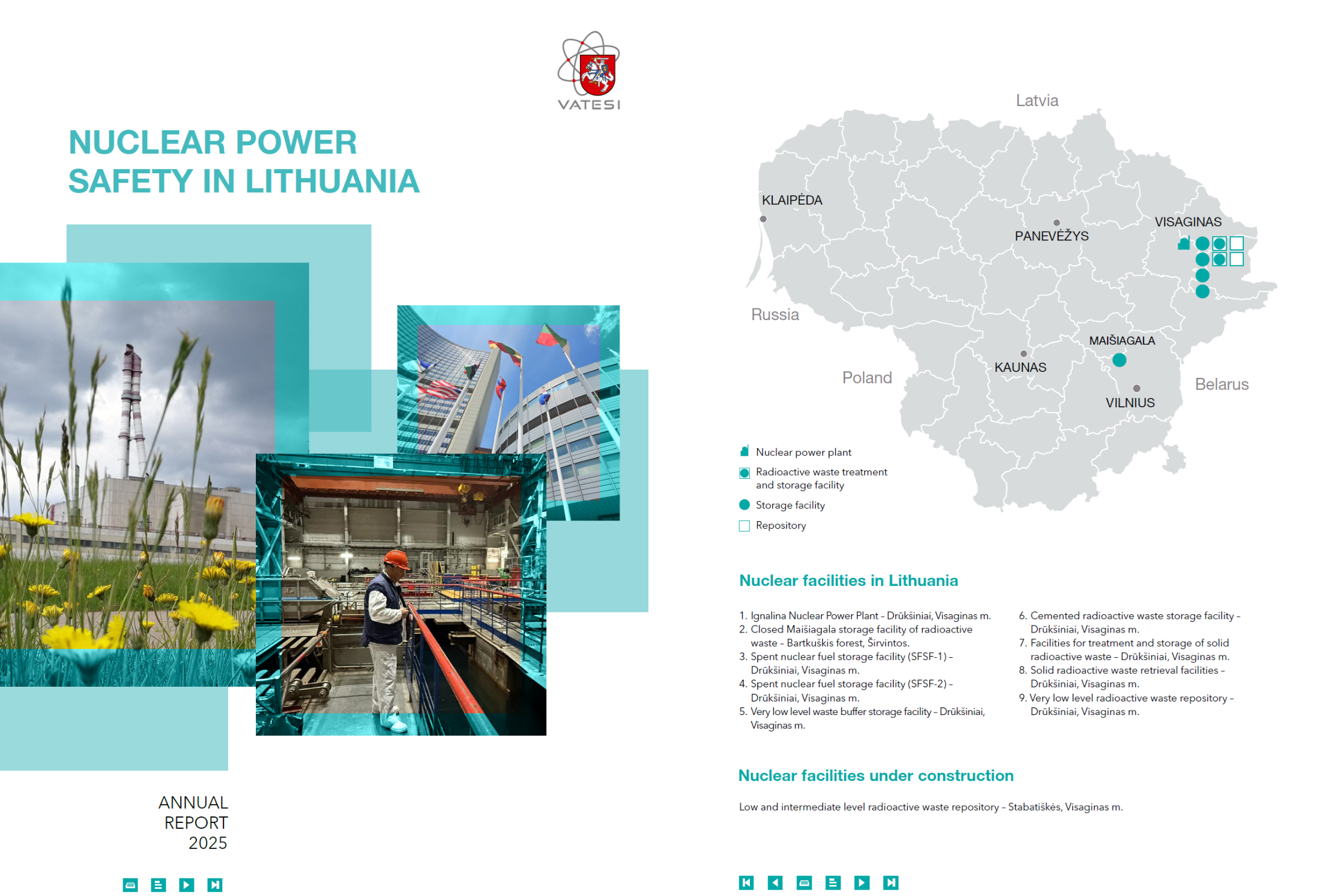
The State Nuclear Power Safety Inspectorate of Lithuania (VATESI) has published its annual publication “Nuclear Power Safety in Lithuania” , providing an overview of the main activities and key developments of 2025.
Main areas of activity
In 2025, there were no events in Lithuanian nuclear facilities or activities involving nuclear and nuclear fuel cycle materials that might have any impact on nuclear safety.
As work intensified on decommissioning and radioactive waste management projects of the Ignalina Nuclear Power Plant, radiological monitoring results showed that the activity levels of radionuclides released into the environment did not exceed the established limits, and the work was carried out safely.
The strong annual results demonstrate that economic entities active in the Lithuania’s nuclear energy sector are making efforts to identify solutions that help manage risks arising from the operation and decommissioning of nuclear facilities, ensuring that the public and the environment are adequately protected.
The continued public concern and attention to Ukraine due to the serious situation at nuclear facilities, in particular at the Zaporizhzhya Nuclear Power Plant, has also required constant monitoring and assessment of the situation. Providing verified and reliable information and responding in a timely manner to the public’s concerns has been, and continues to be, one of the emergency preparedness functions consistently carried out by VATESI.
In 2025, the peer review of fire safety at European nuclear installations was completed. The overall conclusion of the review confirmed that different approaches and solutions are applied across EU countries to address fire hazards, and no significant deficiencies were identified in the fire safety strategies of the installations assessed, demonstrating that the overall framework is coherent. Effective management of fire load and ignition sources, strong leadership, accountability, and a robust safety culture were also identified as key factors contributing to the reduction of fire risk. We will consistently apply this experience in the supervision and assessment of the safety of Lithuania’s nuclear facilities.
Licences and permits
In 2025, VATESI took 26 decisions on the issuance, withdrawal or renewal of licences and permits: one permit issued to commence industrial operation of a nuclear facility, two permits issued for carrying out the dismantling of the Ignalina NPP, one application approved for a transportation permit, and one permit issued for the transportation of radioactive materials provided for in Article 30(1) of the Law on Radiation Protection of the Republic of Lithuania. In addition, VATESI withdrew three licences and amended annexes to 18 licences as part of its supervision of nuclear energy practices involving sources of ionising radiation.
Supervision of economic entity activities
In 2025, VATESI specialists carried out 41 inspection of the activities of economic entities. inspections identified 18 violations and 5 minor infringements of legal requirements, and 1 non-compliance with good practice. Additional 3 violations were identified following a review of safety justification documents and during the ongoing supervision of nuclear facilities. The violations do not have direct harmful effects of ionising radiation on population or the environment, but are related to the prevention of such effects and therefore need to be eliminated in a timely manner in accordance with a plan of measures agreed with the VATESI. All identified violations were rectified by the economic entities in a timely and proper manner.
Unusual events
In 2025, 1 unusual event registered at nuclear facility of Ignalina NPP were rated below the scale (0 level) on the International Nuclear Events Scale (INES) and had no impact on safety. Nuclear safety at Lithuanian nuclear facilities is adequately ensured. Similarly, economic entities operating in the ionising radiation environment at nuclear facilities and holders of small quantities of nuclear material have ensured a high level of safety in their activities.
Implementation of international commitments and international cooperation
At the Review Meeting of the Joint Convention on the Safety of Spent Fuel Management and on the Safety of Radioactive Waste Management, held in Vienna in 2025, Lithuania presented its national report, and the country’s compliance with its obligations under the Joint Convention was confirmed.
VATESI also submitted Lithuania’s 10th national report to the IAEA on the implementation of its obligations under the Convention on Nuclear Safety. This was Lithuania’s first report submitted under the Convention as a country without nuclear installations.
VATESI specialists continued works in working groups of various international organizations aimed at continuously improving the level of nuclear safety, physical security, and radiation protection in Lithuania, Europe and worldwide, exchanged experience and the best practice in nuclear activity regulation and supervision.
In the area of non-proliferation, Lithuania's commitments are being properly implemented – nuclear materials located in the Republic of Lithuania, dual-use nuclear items, research and development related to the nuclear fuel cycle are used only for peaceful purposes. This conclusion is based on the results of inspections carried out by the International Atomic Energy Agency (IAEA) inspectors and is stated in IAEA report on the implementation of safeguards.