

IAEA 68th General Conference Lithuania highlights
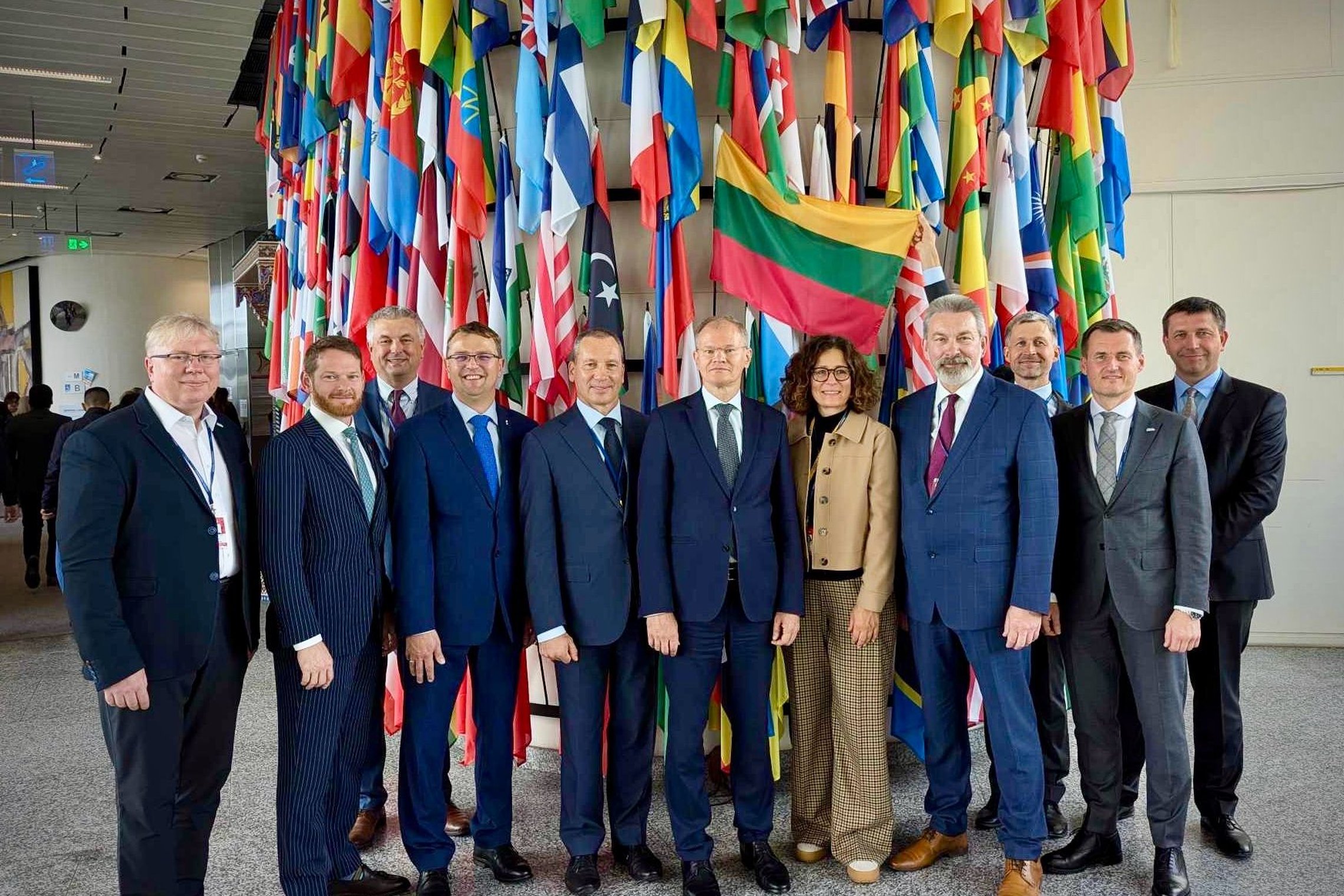
16−20 September 2024, 68th General Conference of the International Atomic Energy Agency (IAEA) was held in Vienna. It was attended by a Lithuanian delegation comprising representatives of the Ministries of Energy and Foreign Affairs, the State Nuclear Power Safety Inspectorate (VATESI), the Radiation Protection Centre and the State Enterprise Ignalina Nuclear Power Plant (Ignalina NPP).
During the conference, the Head of the delegation, Vice-Minister of Energy A. Zananavičius, delivered a presentation by Lithuania, and experts from Ignalina NPP and VATESI presented the experience gained during the implementation of the decommissioning of the Maišiagala radioactive waste storage facility. Members of the delegation took part in various events organised by the IAEA Secretariat and Member States, as well as in a joint exposition on international cooperation on nuclear safety and security organised by the European Commission, Greece, Lithuania, Sweden and Hungary. The Lithuanian Energy Institute has confirmed its intention to work with the US in areas such as advanced small modular reactor technologies, safety analysis, waste management solutions, etc.
Cooperation on reactor dismantling
Head of VATESI Michail Demčenko met with the Director General of the French Institute for Nuclear and Radiation Safety (IRSN), J.C. Niel. IRSN carries out nuclear and radiation risk research and expertise and is a member of an international consortium of experts that will provide technical-scientific support to VATESI in safety assessment documents regarding dismantling the Ignalina NPP reactor facilities.
A preliminary contract was signed in September 2024 VATESI with the expert consortium NucAdvisor, UAB Bureu Veritas, Egis Industries and IRSN.
Licensing and supervision of the decommissioning of the Maišiagala radioactive waste storage facility
Marius Dekaminavičius, Chief Inspector of the Decommissioning Division of VATESI, presented the licensing and supervision activities carried out by VATESI during the decommissioning of the Maišiagala radioactive waste storage facility at an event organised during the conference.
The decommissioning of the Maišiagala radioactive waste storage facility, following the issue of a licence by VATESI, started in 2021. Cold and later hot tests of equipment and systems were carried out in November 2023 in accordance with agreed programmes. Following the VATESI inspections, a licence was issued for the transport of radioactive waste to the radioactive waste management facilities located in the territory of the Ignalina NPP and its treatment in accordance with the established requirements. Once all the waste has been removed, radiological tests have been carried out and the results confirmed, the former Maišiagala radioactive waste storage site can be used for other activities without any restrictions.
Safety of nuclear installations in neighbouring countries
Addressing the plenary of the General Conference, Vice-Minister of Energy A. Zananavičius condemned Russia's aggression in Ukraine, in which the Russian army turned the Zaporizhia nuclear power plant, seized by the Russian army, into a military base, and continues to destroy Ukraine's energy system, thus threatening all of Ukraine's nuclear power plants.
The statement also reminded the international community of Lithuania's concern about the nuclear safety situation in neighbouring Belarus, where the operation of the Belarusian nuclear power plant continues without addressing fundamental environmental, nuclear and radiation safety issues. The Belarusian nuclear power plant is subject to frequent and unreported failures, which means that the safety of the plant must be prioritised over economic benefits in order to protect the region from radiological hazards.
Research and development in the field of civil nuclear energy
The Lithuanian Energy Institute and the US Department of Energy have signed a Letter of Intent to strengthen research and development in civil nuclear energy area. This agreement opens up opportunities for the Institute to work together in areas such as advanced small modular reactor technologies, safety analysis, waste management solutions, etc. By signing the Letter of Intent, both parties committed to working together towards a cleaner and safer energy system, thereby contributing to sustainable development and climate change mitigation.
Last updated: 25-09-2024
Related news:
VATESI participated in International Emergency Preparedness Exercise ECUREX-2026
Belarusian NPP safety problems remain unresolved
IAEA 70th General Conference LT highlights
Report of the IRRS mission to Lithuania published
VATESI annual publication “Nuclear Power Safety in Lithuania”